"Women Authors". An introduction
March 1, 2025
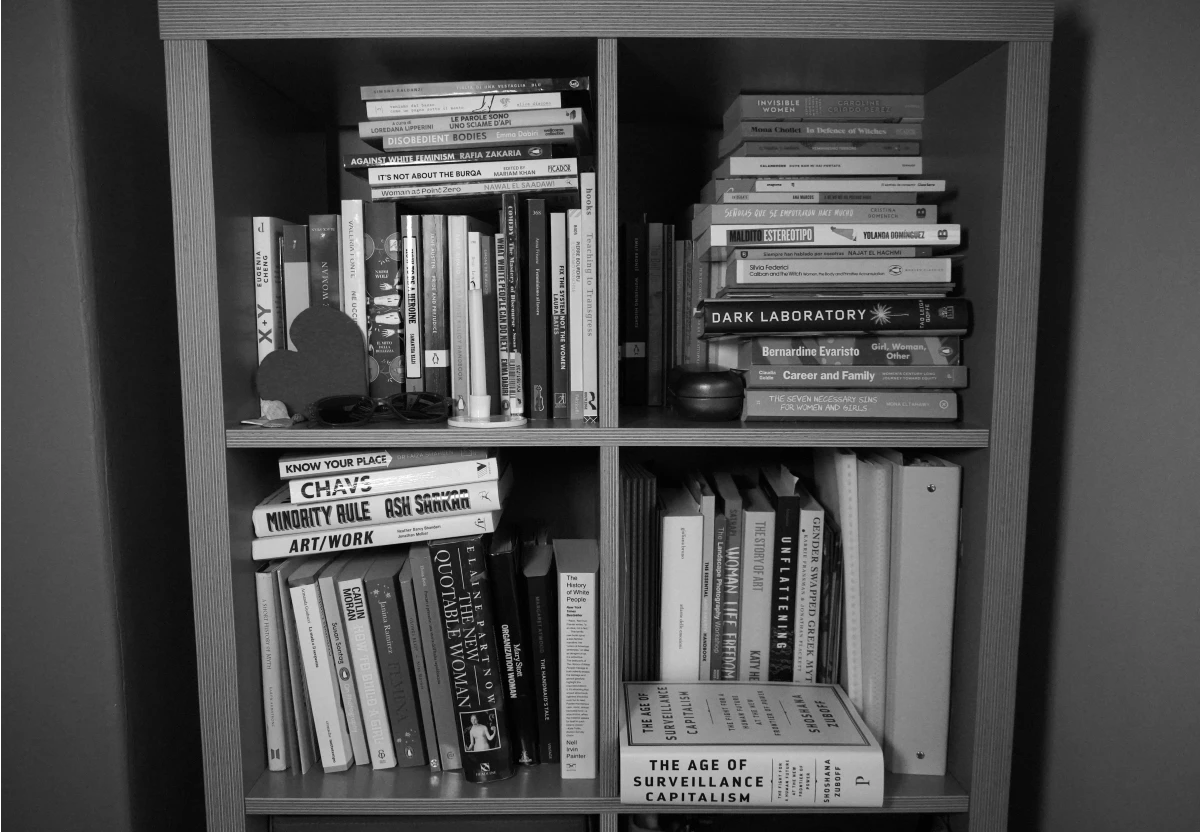
The texts presented in this section are mostly personal memories, reviews and political texts. Each one is inspired by a book written by a woman.
I chose to feature only women because of the education I received: predominantly male, calibrated on the Cartesian epistemological primacy of rationality over everything else. I discovered that women existed in history and that women, too, had made history - and many other disciplines - very late. And since I'm convinced that "discovering" it earlier would have given me a different consciousness and another perspective on the world, I chose to list and comment only on female authors, thinkers, and artists. To give them back the space they didn't have in my education as a girl, and the importance they would have had on my perception of myself and of reality.
Each text I wrote addresses gender and intersects with other axes: class, race, sexuality, geography, ableism, colonialism, and the climate crisis.
Each one expresses a strong desire to be honest, to bring together pieces of life, experiences I thought were exclusively mine, but which over the years I have found politically criticized in essays, short stories, novels, and poems. I have described how these essays, short stories, novels, and poems have given me the tools, or even just the comfort, I needed to not look harshly at myself and at other women. I have described how these books have simultaneously been difficult interlocutors in challenging my prejudices, and important bricks of that bridge to the Other that constitutes the ongoing work toward complex thought.
My collection of writings exudes the urgency to highlight a metamorphosis, an awakening. That of my conscience. Recounting parts of my private life has allowed me to see, almost from the outside, the processes of my growth, passing through the different degrees of my ignorance, the different nuances of my anger, and the gradual dissolution of my naiveté as I grew into adulthood. The resulting picture is a landscape where contradictions and insecurities have been the price I paid every time I decided to push the line of my horizon further, along with a not inconsiderable veil of suffering and the unexpected flash of light of liberation.
The perspective of these works is therefore extremely personal: it is influenced by my own experiences, and by all their limitations. The narrator is a thirty-year-old queer, white, Italian woman, from a farming, migrant, and staunchly Catholic background, characterized by economic and social disadvantage and by a history of abuse and addiction, having been the first to go to high school and university.
I remember finding this type of presentation ridiculous when I first heard it from people in academic circles. Then one day someone asked me: "Where do you know from?". That's how I learned about knowledge positioning and how the geography of points of view is the basis to not elevate one's own experience to a universal system and to build an honest and constructive discussion.
The questions that guided the writing of these texts are diverse. I started asking myself: is it possible to go from being reactionary, misogynistic, sexist, and racist to being their exact opposite? And then: what is the role of culture in shaping people's mindsets and common sense? What is its actual power? What are its limits?
My storytelling is about this. It's about economic and social barriers, about how culture reproduces itself, about how no one is protected from their own biases, and about how important it is to continually question ourselves and engage with what is different from us. It's about how change is impossible when we've never had the space to look at ourselves from afar, and how it's possible when we sincerely need and seek it.