"Poetic Diary", Elizabeth of Austria (1885 – 1889). Why little girls dream of princesses
September 7, 2024
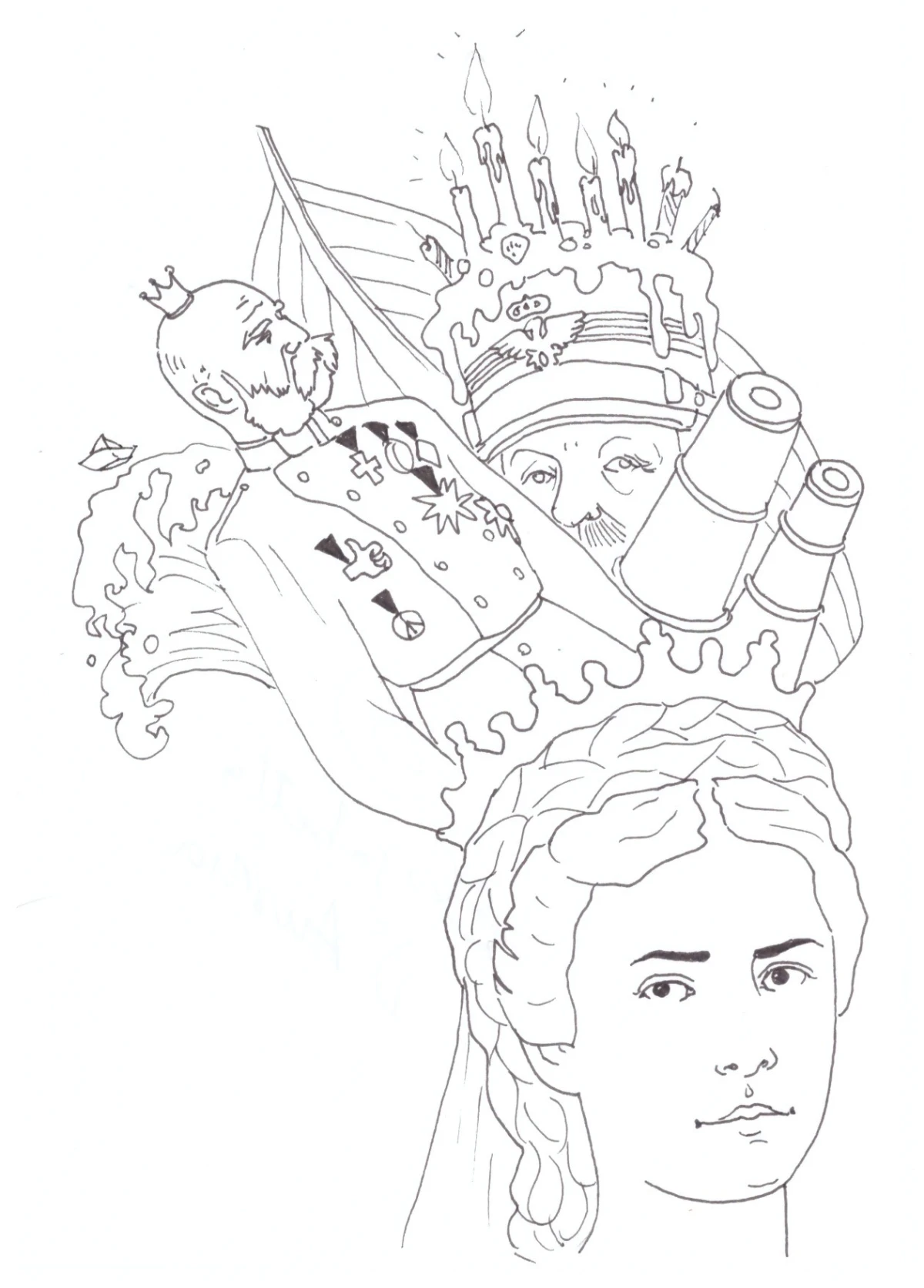
For an Italian girl growing up in the 1990s under Silvio Berlusconi's government and television, finding inspiring female role models wasn't easy, especially when there were no positive female role models even within one's own family. Sure, the women in my family loved me and were strong personalities, but they all were also very unhappy, and carried a heavy baggage of pain with them.
As a child, it was essential to me to find a female figure to look up to, someone who was both a powerful and a happy woman, because I too wanted to be powerful and happy. But, as Marian Wright Edelman recalls, it's hard to be what you can't see.
That is the reason why the figure of Sissi, the Empress Elizabeth Amalia Eugenia of Wittelsbach, became so important to me in my childhood. She symbolized the chance to be something more than an eternally young, super-thin, always half-dressed, voiceless showgirl, as the mainstream culture suggested to me as my only destiny. She was a princess, but not one of those locked in a tower waiting to be saved. She embodied the possibility of being a brilliant woman capable of seeking her own happiness without giving up on herself. For me Sissi was a die-hard, a person who was not willing to change her unconventional character to conform to an external norm, and that made her a powerful person to my eyes. At least this was how Austrian cinema had presented her historical character (The Trilogy of Sissi by Ernst Marischka, 1955 – 1957), as a tenacious, rebellious and loved girl.
I am not here to comment on the classist-patriarchal narrative underlying classic representations of the Empress, which equated a woman's personal fulfillment with super-hetero marital love and happiness with an unlikely royal wealth. Nor to deconstruct how her character is portrayed as unconventional while remaining the repository of all the stereotypical feminine “virtues” such as kindness, altruism and spirit of sacrifice. Instead, here I want to tell how important it was for a little girl to follow the beauty inside the destiny of another woman to seek the same elements in her own future. I want to tell of my personal encounter with Sissi, when I began to glimpse the woman behind her romanticized figure.
I was around twelve years old when I decided to join my grandfather and his group of cheerful retired friends on an organized bus trip to Vienna. It was summer, and it was my first time outside Italy. I remember that before leaving I went to see my grandmothers and great-grandmothers in their dark sad rooms, promising them some souvenirs of the beautiful Sissi and the luxurious rooms where she had lived. The goal for me was, of course, to see the places where my heroine had lived and the traces of her luminous life as Empress, but also to get some tips on how to follow my dreams and be happy. However, after days of whining to convince my parents to let me go and reassuring my grandfather that I would behave, and after 8 long hours spent reading Mickey Mouse on the bus, quiet and good as I had been instructed to be, what I found in Vienna was very different from what I expected.
I visited Schönbrunn, the royal residence of the Habsburgs, following a guided tour. I was convinced the royal palace would be filled with paintings and references to Sissi, but instead, my Empress seemed to have passed through that palace like a shadow. There was almost no trace of her, and that place instead of a banner of pomp and power, seemed to me the golden tomb of a thousand boring mummies. Endless rows of sovereigns, princes and princesses who were not Sissi adorned every wall of the palace, wrapped in damask fabrics, white tights, starched collars, with anonymous, pale faces that seemed annoyed with themselves.
I remember very well when the guide led us into the Emperors' shared bedroom and how happy I was to see there the first portrait of Sissi, even though she didn't seem as beautiful as in the film nor as I had imagined.
In front of that portrait, the guide told a story completely different from the one I had seen on television: that the first years of marriage were a traumatic experience for Elizabeth, who had the task of producing as many healthy male offspring as quickly as possible; that she gave birth to one child after another, alternating between exhaustion and depression; that at 21 she had already had three children; that only after four years of attempts, her first and only son, heir to the Habsburg throne, would be born, only to then commit suicide in his early youth.
The more the guide spoke, the more Elizabeth's room darkened before my eyes, becoming a tomb like the rest of the palace. The blue wallpaper that covered the spaces and the heavy rosewood furniture reminded me of the dark austerity of Catholic churches, not the luminous joys of a happy marriage in Prince Charming's castle. Although far from the extreme humility of the Italian peasant furniture of the twentieth century, the seriousness of the shapes and colours of the imperial bedroom reminded me of the merciless rigour of my great-grandmothers' bedrooms: the rigour of rooms designed for conceiving children under the controlling gaze of a God hanging on the crucifix.
Was that happiness? The more I looked at the room and its Rococo decor, opulent yet unobtrusive, the more Sissi's figure began to resemble that of my great-grandmothers. Was there really that much of a difference? Of course, Sissi was an European aristocratic, cultured and married to the Emperor, while my great-grandmothers were the unwanted daughters of mediterranean sharecroppers, illiterate and married to the neighbor their father liked best. But it seemed to me they shared the same dark life tone. My great-grandmothers, too, had given birth to dozens of children, one after the other, restlessly, praying only for the male, being blamed for the female. No one cared about their tiredness, depression or the life they wanted to live.
Even though separated by the geopolitics of a world that no longer exists, by diametrically opposed social status, by more than a century of wars, technological discoveries and social revolutions, the contours of the miserable lives of my peasant ancestors seemed to fade within the borders of the so-called dream life of my idolized empress.
It was a tragic realization, as if my option of happiness had been taken away, with all its hopes.
I had come to Vienna to find a powerful and happy Sissi, so I could know that one day I too could be powerful and happy. But what I found in the royal palace was instead an ordinary woman, stuck and unhappy, just like all the women I had ever known. Sissi could have been one of my great-grandmothers, with the same darkness of forced motherhood, family bereavements, and repressed frustrations within her. I had looked to Sissi for beauty and hope, to divert my gaze from the miseries of the women in my family, and what I had found was, incredibly, the same vale of tears.
Far from being powerful or happy, my heroine was described to me as a depressed, anorexic, asexual and derided person. She was obsessed with diet and exercise, just like the women who lived in my own era, and like them she too was cheated by her husband with younger women. She too was terrified of aging, so much so that after 40 she covered her face with a black veil. And she too was a constant subject of negative gossip from everyone who knew her. The guide concluded, with a mischievous smile, by telling how the empress would escape from court duties to spend hours having her long hair combed.
I remember very well how deeply betrayed I felt that day in Schönbrunn, the day I understood that Sissi was simply a woman. And I remember very well what being a woman suddenly meant to me: something far removed from light, glory, and happiness. Something that marvelous jewels and dresses of muslin and taffeta could hardly compensate for. Something that prevents life from being better, whether you're a peasant or the first citizen of the Empire. Something different from and contrary to hope.
At the souvenir shop, I chose postcards of the royal palace and lighters with the Empress's face to give to my grandmothers and great-grandmothers, but my heart shattered every time I saw Elizabeth's figure printed on the gadgets. I found it ironic and cruel that even my grandmothers and great-grandmothers looked at Sissi with shining eyes, believing they had before them someone who had made it, when in fact they simply had a mirror, gilded and studded with precious stones, but still a mirror. I was inconsolable. Even all the attention of the elderly ladies on the bus, who tried to cheer me up with sweets and cuddles, were in vain: I had lost the only example of a powerful and happy woman I had. If not even Sissi had had her chance, I certainly wouldn't have it either. It's hard to be what you can't see.
It's not easy to explain how tragic this was for a little girl, even twenty years later. The lack of inspiring female role models is something my male friends never understood because they've never experienced it. They had the footballer, the athlete, the comedian, the scientist, the writer, the artist, the mayor, the mechanic, the surgeon, the rapper, the president, the general, the chef, the firefighter, the pilot—an endless list of powerful role models, each with a man's face to represent them. The women I could look up to were the waitress, the secretary, the nurse and the teacher, or the model, the actress, the singer, if I ever developed a nice pair of legs and breasts. It's hard to be what you can't see.
Having a heroine to look up to can give you hope, it can show you a way of being that no one has ever taught you and that you've never seen, it can point to an alternative path for your future. But what happens if this heroine is also alone, sad and hated? What if mainstream culture describes her as a dumb Disney princess and the tour guide tells you she was a capricious and ridiculous posh woman? You think there's just the reality, that women will be women, and you turn to the roles society has assigned to your gender. At least that's what I did, trying to fit myself into one of the female roles at my disposal, preferably one that didn't require nice legs and tits. And that's how I became first a waitress and then a teacher, doing the only things I believed I could do, accepting that my gender was synonymous with resignation, being what I have seen.
I'm not saying that if Sissi had been a happy person, I would have donned a corset and rushed off to marry a nobleman and become the head of some monarchy. But the lack of diversity in female role models available to me during my childhood and adolescence did affect the way I imagined myself in the future, and from this point of view Sissi is just a sad and effective example. I think I would have given a different importance to her personality if it had been presented to me in a way that enhanced her agency, and that would have given me a little more creativity in thinking about my life choices too.
It took me many more years to discover that Sissi had truly been the powerful and nonconformist woman I had dreamed of, and that it was precisely her unconventional strong nature that had made her a tormented, difficult, and unhappy person. It took me many years also to understand that if she reminded me of the unhappiness of the women in my family, this wasn't something negative, but the sign of a more complex connection, which unites women of different eras, classes and cultures. Just as her not being loved was also the symbol of what women receive -regardless of their era, class or culture- when they step out of their place, seeking a part other than the one assigned to them. It took me years of passionate reading (Brigitte Hamann and her biography of the Empress and the Empress's own diaries, among many others); years of growth as a woman through all the contradictions and disillusions that this entails; years of encounters, dialogues and clashes with feminist theories.
The Empress taught me something after all. That it is not by conforming to the rules that one becomes happy, but that going against them does not ensure a happy ending either. That the choices you make to be true to yourself come at a price, and that if you are a woman that price is always higher.
In her Poetic Diary, Elizabeth wrote:
“I am a seagull, of no land,
I call no shore my home,
I am bound to no place,
I fly from wave to wave”.