"A Room of One's Own", Virginia Woolf (1929). How to escape the kitchen
September 1, 2024
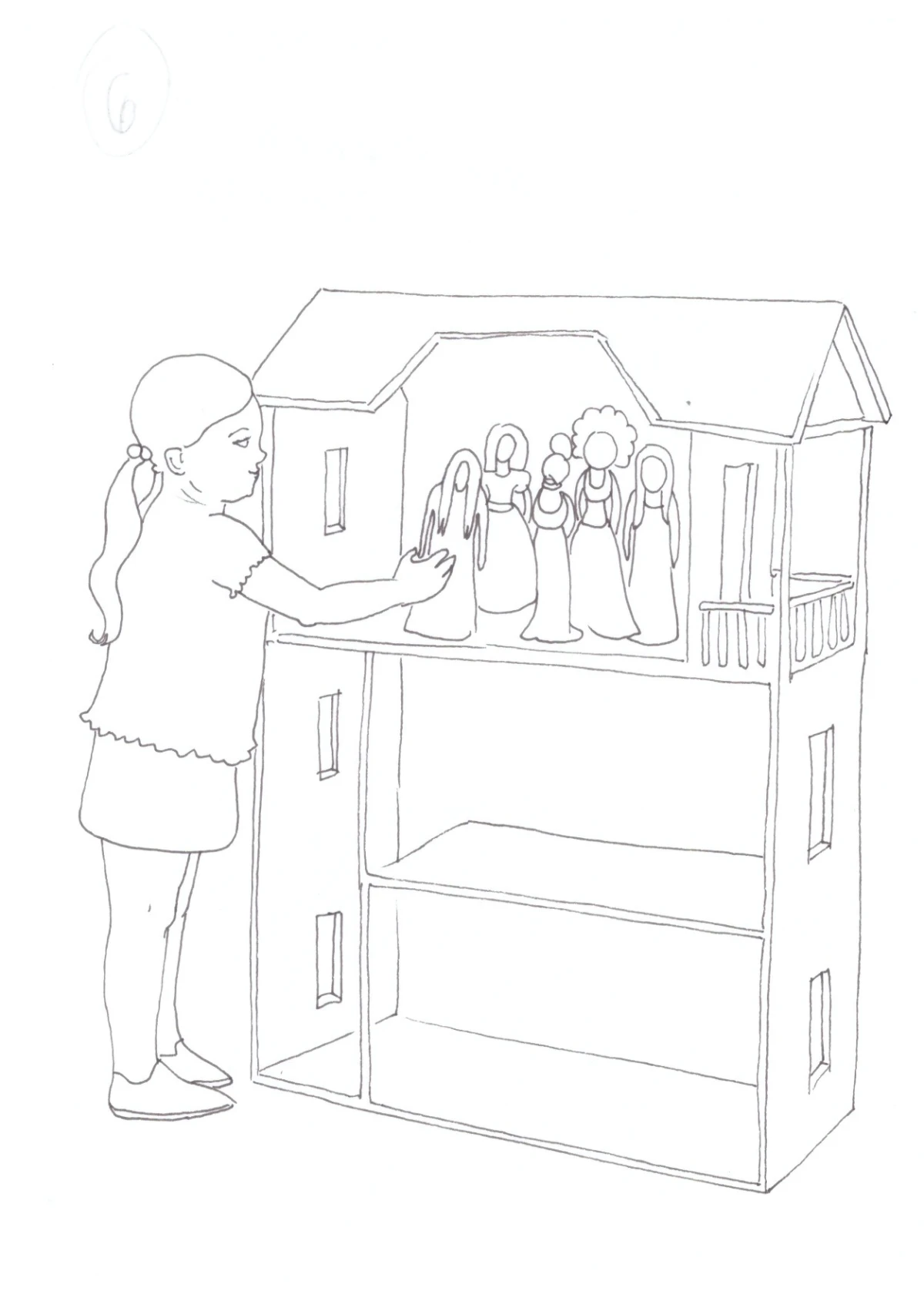
Before reading "A Room of One's Own", I had never thought about my space in a political way. Until that moment, space was only what bodies occupy. Something at once material (the room) and immaterial (the emptiness of a room). And inevitable (my body inside the room).
When I was a kid I used to work in the kitchen as all the women around me did, unlike men who all had their own studios. While my father had his painting room and my grandfather had his workshop, my mother, my grandmother, my two great grandmothers and I stayed in the kitchen. "It's more comfortable" they used to say "So we're ready to cook and set the table", but it wasn't comfortable at all, because the space was small for a single person and it was unmanageable for two. Imagine for four or five of us. Every centimetre had to be optimized. Whatever was put on the table soon had to be removed and accumulated in makeshift storage in a corner to then be taken back.
The grannies – and mum when she was at home - worked with cloth, making shirts and dresses or they cooked, preparing preserves, jams and cakes in addition to regular meals. I did my homework and drew.
The rigour of little space and little time - because the kitchen is where you eat, not where you work, as my grandfather remembered us every day - imposed a hierarchy of actions: it's okay to occupy the table for school homework because duty comes first. But not for drawing, which risked requiring a piece of the table so large as to impede women's cooking and tailoring actions.
That is the reason why I started drawing on tiny pieces of makeshift paper, which were easy to find (scraps, clippings, paper napkins) and easy to hide (I made them quickly disappear inside notebooks when I secretly drew instead of doing homework).
When I was caught drawing at the kitchen table, the narrative always followed the same pattern, moving from ethics to morality, praising ontology and then arriving at pragmatism.
“Have you finished your homework yet, since you're drawing?”.
Ethics, a reminder of the value of responsibility.
"So, if you've finished your homework, you should help with the housework instead of drawing".
Morality, duty vs. pleasure (and housework as more morally appropriate duties for a girl).
"Drawing will never get you anywhere in life".
Ontology, the being reduced to results.
"Anyway, the kitchen isn't the right place to do these things".
Pragmatism, keeping spaces for their specific uses.
Had there been another place in the house where I could draw, I would have used it but there wasn't. Everyone knew that and nobody cared about it. The kitchen was the only heated room in the house, the only one with a table, chairs, and adequate lighting. The rest were several bedrooms with basic furniture.
Saying that the kitchen wasn't the right place to work had three meanings. The first was that only men's work was recognized as such (housework wasn't). The second was that if the kitchen couldn't be used as a space to do what women wanted, doing what women wanted was therefore forbidden: the kitchen was the only space in the house we, as women, had for ourselves. The third was that if no one had thought of a physical space for women's activities, it meant that it was not considered possible that women could want to do something that was not related to the kitchen.
Our activities were therefore expendable, negligible, unimportant.
And that's how we felt, or at least how I felt, every time the kitchen table was cleared to prepare meals, when our things were hidden in a corner so as not to bother anyone and then retrieved later, once lunch and dinner were over, to then reappear as if nothing had happened. School materials, sheets, cases, sewing baskets, scissors, balls of wool, fabrics, pattern magazines, they advanced and retreated like the tide.
This daily moving led me to feel that the work we made was clandestine.
Space was for me first and foremost something material: the kitchen, the stove, the light, the chairs, all our things on the table hidden and found. And immediately afterwards it was something immaterial: everything impalpable that surrounded my body. The short distance between my skin and that of others, between my ears and their words, between my eyes and their actions. It was the rules of men – coming in the kitchen for eating and watching the tv -, their authority, their power, their confidence, their stories about the world outside. And the gazes of the women - sharing the table, the light, the warmth -, their smells, their laughter, their words of comfort and reproach, their deafening silences.
Space was something inevitable because I couldn't avoid occupying it: I had to be somewhere.
I don't remember suffering because of this. On the contrary, I remember enjoying secretly drawing caricatures of my grannies to make them angry. "You're terrible," they would say, but then they would laugh and tell me I had such an imagination before throwing away my sketches.
I didn't really care that my drawings were thrown away, it was something I considered absolutely normal in a line of thought that erased the value of any of our activities.
I liked drawing and drawing gave me pleasure, that was enough for me. At the same time though, I knew there was something wrong with this action: that the space I was taking wasn't mine, that I had no right to take it, that the reason I was taking it was futile, and that the work I was doing was a waste. Of time, of material, of space.
Funny enough, as I grew up I continued to draw in small formats and on cheap pieces of paper.
This proved to be a problem when I enrolled at the Academy of Fine Arts where all my colleagues presented portfolios of heavy papers and worked on giant canvases.
When the director of my painting course told me that he would give me a workspace in the common Atelier, I replied that I only made small drawings.
Expendable, negligible, unimportant drawings.
It was as if I had been asked for the first time to leave the kitchen to occupy my grandfather's or my father's workshop, the male space. Something inexplicably exaggerated and wrong.
Put in front of a large white paper for the first time, with all the space to draw and to paint, without the need to hide and to move my materials three times a day, I felt suddenly uncomfortable. Out of place. A traitor. An impostor.
I didn’t leave the kitchen. At the Academy of Fine Arts I continued making small drawings on scrap paper, clandestinely, blaming myself because I was unable to do a great piece of art, and being blamed by my family for enrolling in that useless University, “Drawing will never get you anywhere in life!”.
It took me many years - and the late reading of "A Room of One's Own" - to realize that for me space had always meant resignation, adaptation, accustoming to discomfort, concealment. And guilt when I tried to require some for myself.
I wonder how different life would have been for me, and for the women in my family, if space had been recognized as something we were entitled to, if we had been taught to claim it and occupy it, starting from home, from a normal sheet of paper, and extending the idea to the public space.
I wondered how many times we decided to remain in the kitchen instead of accepting better conditions because we were afraid, we felt inadequate, unworthy, or simply because when you grow up in a cage, the cage becomes the only world you know and the only one you feel comfortable in.
These are questions I asked myself several years after the death of one of my grannies, Maria, when I found hundreds of my pen-drawn paper napkins that she had rescued from the trash and hidden in a kitchen drawer. She had kept them in her safe place: the drawer for guest tablecloths. She was obsessed with ironing the tablecloths so that guests would find them perfect, like the ones in the restaurant. None of us dared touch that drawer and so it saved my drawings from oblivion, preserving them under thick layers of inviolate ironed fabric, as a shroud does with the body it envelops.
The effect this discovery had on me was comparable to the effect an archaeological finding can have on history: something revolutionary, capable of challenging established narratives and rewriting the perspective with which we view our past.
When I decided to empty Grandma Maria's tablecloth drawer, I was already a young woman who was struggling to build her own independence, making many choices against her family's expectations and carving out a space for herself outside the walls of her own kitchen. I was at that point in my life where I needed to prove to myself that I was different from the women in my family, creating the opportunities that had been denied to them or that they didn't know they could take.
In that specific moment, opening Grandma Maria's drawer and finding my drawings inside it was like receiving a sign from the past, a hug that traveled through time, a pat on the back that told me "You're doing well, this is the right direction, take your space." It was like discovering a space in the hearts of my loved ones that I didn't think I had.
Knowing that my work was precious to my grandmother Maria gave me back a huge sense of self-love.
With that gesture, my grandmother created a place for my work, and therefore for my individuality. She protected it from that normalized mechanism that gradually erased, one after the other, all the women in my family, making them invisible in a kitchen, making an alternative in their futures invisible to themselves.